Pergamon Asclepion: The Ancient Healing Center Where Dreams Could Also Cure
Long before modern hospitals existed, ancient Pergamon was home to a place where people came seeking more than medicine. Here they found water, rest, treatments, music, rituals, physicians… and, according to the beliefs of the time, even answers in their dreams.
On the hills of present-day Bergama, in Türkiye's Aegean region, lie the remains of the Pergamon Asclepion, one of the most remarkable healing centers of the ancient world.
But this was not simply a temple.
It was a complex where medicine, religion, architecture, psychology, hygiene, exercise and rest came together.
And perhaps the most fascinating part is that some of the questions people asked here more than two thousand years ago are still relevant today:
How do we heal a person? Is it only the body that needs treatment, or does the mind need healing too?
What Was the Pergamon Asclepion?
The word Asclepion comes from Asclepius, the Greek god of medicine and healing.
Asclepions were sanctuaries dedicated to this deity and served both religious and healing purposes. Several important Asclepions existed throughout the Greek world, including the famous centers at Epidaurus and Kos.
But the one at Pergamon became particularly important.
The sanctuary was located outside the ancient city of Pergamon and began developing especially from the 4th century BC. During the Roman period, it was expanded and monumentalized, and many of the structures visible today belong to transformations carried out in the 2nd century AD, during the reign of Emperor Hadrian.
Pergamon later became an important Roman metropolis and the capital of the Roman province of Asia. Its Asclepion was renowned as a major healing center within a city that was also famous for its culture, science and architecture.
Who Was Asclepius?
To understand the Asclepion, we first have to meet its main character.
Asclepius was the Greek god of medicine.
According to mythology, he was the son of Apollo and Coronis.
The legend tells us that Asclepius acquired extraordinary knowledge of the healing arts. Some versions of the myth even say that he became capable of bringing the dead back to life.
And that created a problem.
If human beings could escape death, the balance between gods and mortals would be threatened.
For this reason, Zeus eventually struck Asclepius with his thunderbolt.
But his legacy survived.
And one element associated with his story is still recognized throughout the world today:
The Serpent of Asclepius 🐍
The serpent became closely associated with Asclepius and healing.
Why a serpent?
In the ancient world, the snake could symbolize renewal and regeneration, partly because of its ability to shed its skin.
Over time, the image of a serpent coiled around a staff — the Rod of Asclepius — became one of the best-known symbols of medicine.
The Journey Toward Healing Began Before Entering the Sanctuary
One of the most fascinating features of the Asclepion was its architecture.
A patient did not simply walk in, see a doctor and receive a prescription.
The journey itself was part of the experience.
The sanctuary was reached through a monumental route known as the Via Tecta, a sacred road approximately one kilometer long, partly covered and ending in a porticoed section.
Imagine a patient slowly walking along this road.
The noise of the city is left behind.
The sanctuary comes closer.
You hear the water.
You see the columns.
You breathe.
And little by little, you enter a completely different world.
The architecture itself was preparing the patient for what came next.
Water: One of the Essential Elements
Water played an enormous role in ancient healing centers.
At the Pergamon Asclepion there were sacred water sources, and water formed part of both the religious experience and the therapeutic practices. The sacred spring of the Asclepion is still flowing today.
Patients could experience treatments involving water, bathing, rest and various therapeutic practices.
The sound of running water also contributed to the atmosphere.
And here we encounter an idea that feels surprisingly modern:
The environment itself could be part of the healing process.
How Were Patients Treated?
There was no single treatment.
Therapies could vary depending on the patient and their condition.
Historical sources mention practices such as:
- water and bathing;
- mud treatments;
- rest;
- fasting and different dietary regimes;
- bloodletting;
- various therapies;
- music;
- and the famous ritual sleep.
Of course, we should not imagine these practices as an ancient version of modern medicine. Many were deeply connected to the religious beliefs and medical understanding of the ancient world.
But there is something fascinating we can recognize:
Ancient people understood that recovery could depend on many different factors, not simply on a physical intervention.
When the Doctor Was a God: The Incubation Ritual
And now we come to one of the most fascinating practices of the Asclepion.
Incubation, or incubatio, was a ritual practice involving sleep.
The patient would sleep in a designated space, hoping to receive a sign, vision or instruction from Asclepius during the night.
According to the belief of the time, the god could appear to the sick person and reveal how they should be treated.
The dream became a kind of divine medical consultation.
Imagine the scene:
It is night.
The patient lies down.
There is silence.
You can hear the water.
The priests are nearby.
The patient closes their eyes.
And waits.
They are not simply waiting to fall asleep.
They are waiting for the god to visit them in their dreams.
The sleeping areas of the Asclepion are traditionally associated with this practice of ritual incubation.
Medicine or Religion?
This is one of the most interesting questions to ask when visiting the Asclepion.
Today, medicine and religion generally belong to different spheres.
But for many ancient societies, the distinction was not so clear.
Illness could have a physical dimension, but also a spiritual and psychological one.
That is why the Asclepion brought together:
the physician + the priest + ritual + water + rest + exercise + diet + music + sleep.
This does not mean that ancient people had medicine equivalent to ours.
It means that they had a much more integrated understanding of the patient's experience.
The Sacred Tunnel: One of the Most Mysterious Features
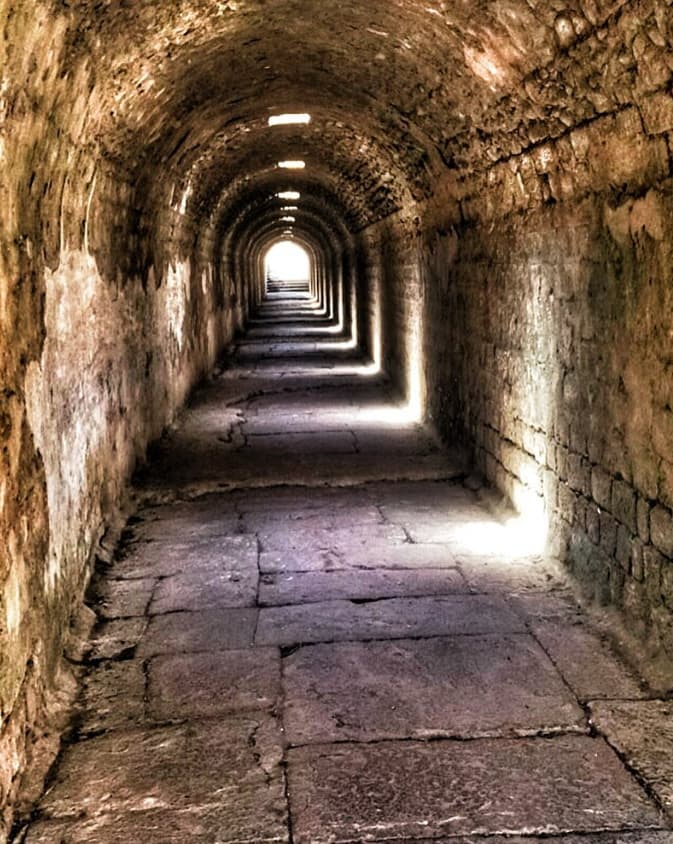
Among the structures of the Asclepion, one feature continues to fascinate visitors: the underground passage.
Patients could walk through this dark and quiet space while the sound of water helped create a very particular atmosphere.
For ancient visitors, the experience could reinforce the feeling that they were entering into contact with the divine.
There is, however, an important distinction to make.
We should not present it as established historical fact that priests deliberately "tricked" patients using hidden techniques.
It is better understood as part of a ritual environment designed to create an experience of healing and contact with Asclepius.
The place was not only intended to heal the body. It was also designed to inspire the patient to believe that healing was possible.
The Theatre: Why Was There a Theatre in a Healing Center?
This is one of the questions that often surprises visitors.
Because yes:
The Asclepion had a theatre.
And it was not a tiny theatre.
The complex included a theatre with a capacity of approximately 3,500 spectators.
Why?
Because treatment was not limited to medical intervention.
Music, performances and entertainment were part of life at the sanctuary.
Today we often talk about emotional well-being, stress reduction and the relationship between the mind and body.
The people of Antiquity did not use our scientific terminology, but they understood that a person's emotional state could influence their experience of illness and recovery.
Galen: The Physician from Pergamon Who Conquered Rome
If there is one person we should remember when talking about medicine in Pergamon, it is Galen.
Born in Pergamon in the 2nd century AD, Galen of Pergamon became one of the most influential physicians of the ancient world.
He was a physician, surgeon, philosopher and student of anatomy.
He worked with gladiators and later practiced medicine in Rome.
His writings had an enormous influence on medicine for centuries.
UNESCO also highlights Pergamon's connection with Galen and his education there.
So when we walk through Pergamon, we are not simply visiting an ancient city.
We are walking through a place connected to one of the most important figures in the history of medicine.
Aelius Aristides: The Patient Who Left Us His Story
One of the most valuable figures for understanding life at the Asclepion is Aelius Aristides, a famous orator of the 2nd century AD.
Aristides was a patient at the Asclepion and described his experiences of illness and treatment in his work known as Hieroi Logoi, or Sacred Tales.
Thanks to testimonies such as his, we can get closer to the experience of an ancient patient and learn about some of the practices connected with the sanctuary.
And this completely changes the way we see the site.
Because we are no longer looking only at:
columns + stones + ruins.
We can imagine people.
People arriving sick.
People who were afraid.
People who were waiting.
People searching for a solution.
Was the Asclepion Really a Hospital?
Not exactly.
Calling it a "hospital" can help a modern traveler understand its general purpose, but historically the term is too simplistic.
The Asclepion was, at the same time:
a sanctuary + a healing center + a ritual space + a place of rest + an architectural complex + a social center.
Ancient medicine did not operate according to the structure of a modern hospital.
Nevertheless, the Asclepion represents a fascinating chapter in humanity's long search for health and healing.
The Asclepion and the Modern Idea of Wellness
Perhaps the most interesting thing for a 21st-century visitor is discovering how much of our modern language about well-being has unexpected echoes in this ancient place.
Today we talk about:
- getting enough sleep;
- reducing stress;
- exercise;
- healthy eating;
- spending time in nature;
- using music;
- mental health;
- creating relaxing environments.
At the Asclepion, we find several of these ideas — although in completely different historical and cultural contexts.
We should not say that the ancient Greeks "invented modern wellness."
But we can recognize that the idea of caring for the human being as a combination of body and mind is much older than we might imagine.
Pergamon: Much More Than the Asclepion
The Asclepion cannot be fully understood without knowing the city around it.
Pergamon was one of the great cities of the Hellenistic world.
It was the capital of the Attalid dynasty and became an important political, artistic, scientific and cultural center.
Its famous acropolis was home to monuments such as the Great Altar, the theatre, the Temple of Athena, the gymnasium and one of the great libraries of the ancient world.
Later, under Roman rule, Pergamon continued to be a city of enormous importance.
Today, the cultural landscape of Pergamon preserves traces of Hellenistic, Roman, Byzantine and Ottoman periods, which helps explain its extraordinary historical value.
In 2014, Pergamon and its multi-layered cultural landscape were added to the UNESCO World Heritage List.
Why Visit the Pergamon Asclepion?
Because it is one of those places where history stops being a list of dates.
Here, you can walk through the same space where, almost two thousand years ago, a sick person might have arrived looking for hope.
You can follow the ancient sacred road.
You can imagine the sound of the water.
You can picture patients sleeping and waiting for a dream.
You can stand inside the theatre.
And you can remember that, long before modern medicine, human beings were already asking a fundamental question:
How can we relieve suffering?
Perhaps that is the true greatness of the Asclepion.
Not that it had all the answers.
But that more than two thousand years ago, people were already trying to find them.
How to Visit the Pergamon Asclepion
The Asclepion is located in Bergama, İzmir Province, in Türkiye's Aegean region.
Today, the archaeological site is managed by the Ministry of Culture and Tourism of Türkiye.
According to the currently published official information, the site is open every day from 08:30 to 20:00, with ticket sales ending at 19:15. Opening hours can change depending on the season, so we recommend checking the official information before your visit.
The Asclepion is ideally combined with a visit to the Acropolis of Pergamon. Together, they reveal two very different sides of the ancient city:
The Acropolis represents the power, culture and monumental grandeur of Pergamon.
The Asclepion represents its medical, religious and human dimension.
Frequently Asked Questions About the Pergamon Asclepion
What does Asclepion mean?
An Asclepion was a sanctuary dedicated to Asclepius, the Greek deity associated with medicine and healing.
Where is the Pergamon Asclepion?
It is located in Bergama, in İzmir Province, western Türkiye.
Who was Asclepius?
He was the Greek god of medicine. His symbol, the staff with a serpent, remains associated with medicine today.
Did ancient patients sleep at the Asclepion?
Yes. One of the known practices was incubatio, in which patients slept while hoping to receive a sign or healing associated with Asclepius.
Who was Galen?
He was one of the most important physicians of Antiquity. He was born in Pergamon and later developed much of his career in Rome.
Was there a theatre at the Asclepion?
Yes. The complex had a theatre with a capacity of approximately 3,500 spectators.
Was the Asclepion a hospital?
Not in the modern sense. It was a healing sanctuary where medical, religious and therapeutic practices came together.
Is Pergamon a UNESCO World Heritage Site?
Yes. Pergamon and its Multi-Layered Cultural Landscape were inscribed on the UNESCO World Heritage List in 2014.
One Last Question Before We Leave...
When you visit the Asclepion, try not to think of yourself as simply looking at ruins.
Imagine a man or woman arriving here almost two thousand years ago.
They are sick.
They are afraid.
They have already tried other solutions.
Now they have traveled a long way to reach Pergamon.
They enter through the sacred road.
They hear the water.
They see the sanctuary.
The priests welcome them.
They are told to rest.
And at night, they lie down.
They close their eyes.
And they wait.
They wait for Asclepius to appear in their dreams.
Perhaps we will never know exactly what those patients dreamed about.
But we know one thing:
They came here looking for hope.
And perhaps that is why, more than two thousand years later, the Pergamon Asclepion remains one of the most fascinating places to explore the history of medicine and, above all, the history of humanity itself.
✈️ Discover Pergamon with ViaTurquia
Pergamon is much more than an archaeological stop.
It is a city where mythology, medicine, science, religion, art and power come together.
From the monumental Acropolis to the ancient Asclepion, every stone tells a different part of Anatolia's story.
At ViaTurquia, we help you discover these places through stories, historical context and expert explanations in English and Spanish, turning your journey through Türkiye into much more than a visit to ancient ruins.
ViaTurquia — Discover Türkiye Through Its Stories.