Çatalhöyük: The Birth of the World's First Great City
When we think about the world's earliest cities, ancient Egypt and Mesopotamia are usually the first civilizations that come to mind. However, one of the oldest and most remarkable urban settlements in human history is located in the heart of Anatolia, in present-day Konya Province, Türkiye.
Welcome to Çatalhöyük, a place where a completely new way of life began approximately 9,000 years ago.
A Journey to the Neolithic Age
Let's travel back in time to 7100 BC. The landscape of Anatolia looked very different from what we see today. Dense forests covered the region, lakes were abundant, and wild animals such as leopards, bears, aurochs, and even lions roamed these lands.
Survival was never easy. Every day was a struggle against nature. Yet, in the middle of this challenging environment, an extraordinary community emerged—one that would forever change the course of human history.
The World's First Great City
Archaeologists consider Çatalhöyük to be one of the world's earliest cities and one of the oldest known examples of organized urban life.
At its peak, the settlement was home to approximately 8,000 inhabitants, an astonishing population for the Neolithic period. Considering that the entire population of Anatolia at that time is estimated to have been between 50,000 and 70,000 people, Çatalhöyük was truly a prehistoric megacity.
It was far more than a simple village—it was a center of innovation, cooperation, agriculture, trade, and human development.
A Discovery That Changed Archaeology
Hidden beneath the soil for thousands of years, Çatalhöyük was rediscovered in 1958 by British archaeologist James Mellaart.
His excavations uncovered a surprisingly sophisticated society. The houses, wall paintings, sculptures, and burial practices offered an entirely new understanding of how people lived thousands of years before the invention of writing and the rise of the great empires.
Decades later, archaeological research continued under the direction of British archaeologist Ian Hodder, whose work revealed even more about the city's remarkably complex social organization.
A City Without Streets
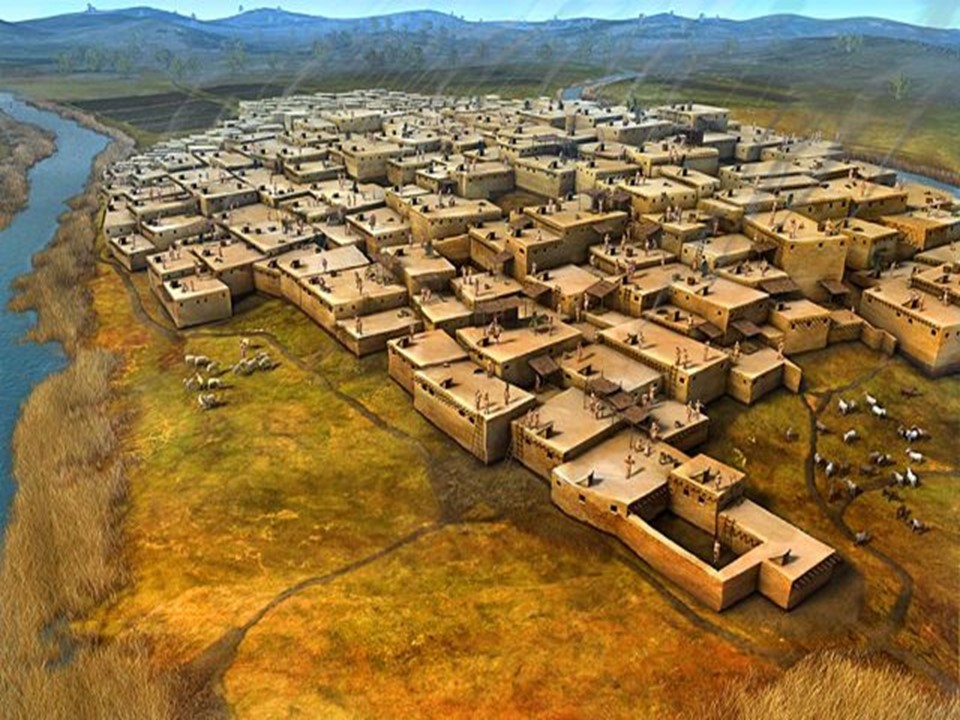
One of the most fascinating aspects of Çatalhöyük is that it had virtually no streets.
The mudbrick houses were built directly next to one another, creating a dense urban landscape. Residents moved across the rooftops and entered their homes through openings in the roof using wooden ladders.
Seen from above, the settlement resembled a giant honeycomb, with rooftops serving as the city's streets.
The Volcano That Became History
From Çatalhöyük, the inhabitants could see the majestic Mount Hasan, one of Central Anatolia's most important volcanoes.
When the volcano erupted, it left a profound impression on the community. Inspired by this dramatic event, they painted what many researchers believe to be one of the earliest landscape paintings ever created.
Many experts also believe that this artwork may represent the oldest known city map in human history, depicting the settlement with Mount Hasan rising behind it. If this interpretation is correct, it would be the earliest urban plan ever produced by human hands.
A Legacy That Lives On
Çatalhöyük is much more than an archaeological site—it is a window into humanity's origins.
Here, many of the foundations of modern civilization began to take shape: community living, organized agriculture, trade, artistic expression, and an advanced social structure.
In recognition of its outstanding universal value, Çatalhöyük was inscribed on the UNESCO World Heritage List in 2012, becoming one of the world's most significant archaeological treasures.
Visiting Çatalhöyük is a journey back to the dawn of civilization, offering a unique opportunity to discover how the first city dwellers lived more than nine thousand years ago.